7/8/2026
2011 Subaru Outback 3.6R Review Kenya: Why this car is better than crossovers and SUVs
Few station wagons have earned the kind of loyal following in Kenya that the Subaru Outback enjoys, and the fourth-generation model remains a favourite among buyers who want genuine off-road capability without stepping into a full-size SUV. This particular model, the 3.6R variant, sits at the top of the Outback's engine lineup and offers a driving experience quite different from the more common 2.5-litre versions found on Kenyan roads. The Outback tends to attract a specific type of buyer: those who value space, all-weather capability and a bit of highway muscle over ultimate fuel efficiency. At 0-60 Motoring, we help buyers make informed vehicle decisions through professional car consultancy and vehicle sourcing, and this review is meant to give you a clear, honest picture of what living with a 3.6R Outback actually involves including the costs many sellers won't mention upfront.
QUICK VEHICLE SUMMARY
Make: Subaru
Model: Outback 3.6R (BRF)
Year: 2011
Engine: EZ36 3.6L naturally aspirated 6-cylinder boxer
Power: 260 hp
Torque: 350 Nm
Fuel economy: 10–11 km/L (highway), 7–8 km/L (city)
Drive type: Symmetrical all-wheel drive, 5-speed automatic transmission
Ideal buyer: Highway drivers, families needing space, buyers prioritising reliability and off-road capability over fuel economy
EXTERIOR DESIGN
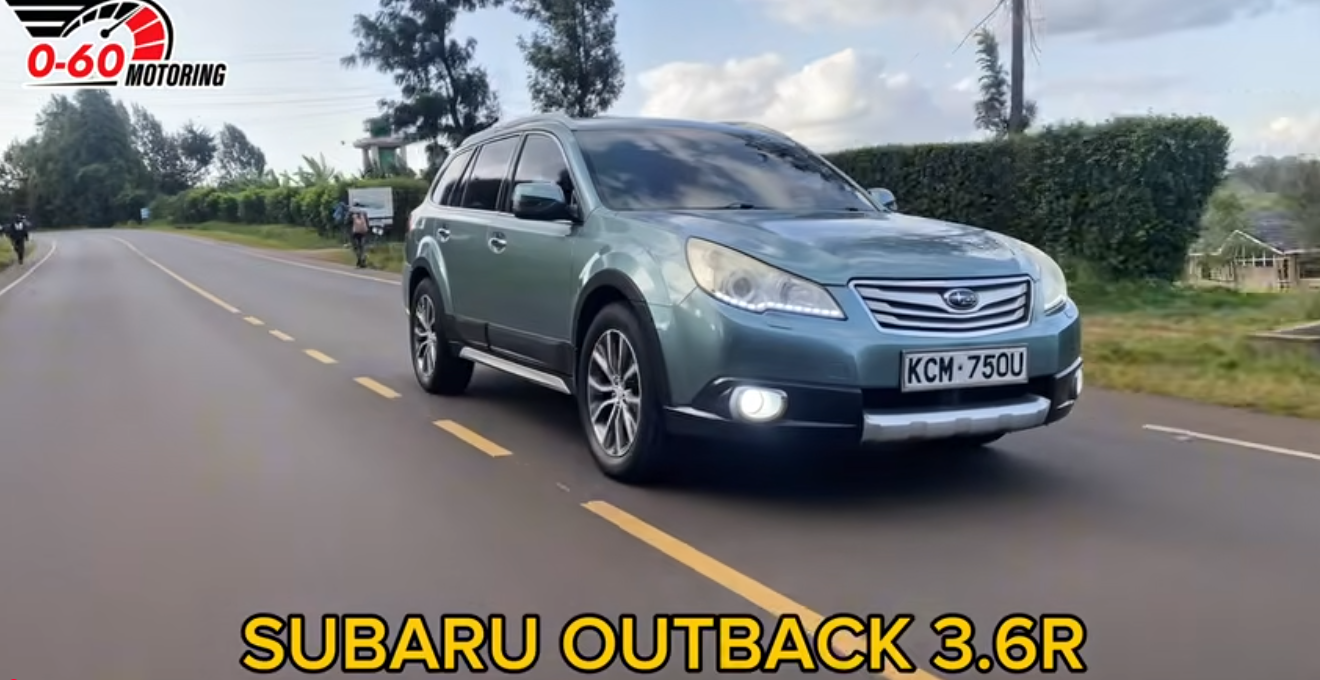
The BRF generation moved the Outback's design in a more muscular direction compared to its predecessor, the BP. Wider wheel arches with protective plastic cladding give the car a more rugged stance, while 18-inch alloy wheels fill out the wheel wells nicely. Buyers coming from the earlier BP generation will notice the loss of frameless doors, and the exhaust now exits facing downward rather than protruding from the rear bumper — small details, but ones that longtime Subaru enthusiasts in Kenya do notice and discuss.
Ground clearance sits at a genuinely useful 22 cm, putting this wagon closer to a Forester in terms of off-road ability while retaining the low centre of gravity and stability of a conventional estate car. For Kenyan roads — where potholes, murram sections and occasional flooding are a fact of life — this clearance is a real practical advantage over a typical sedan or hatchback.
Buyers should note that this generation was sold in two phases: a pre-facelift version (2009–2010) and a facelift version (2013–2014), distinguished mainly by fog lamp size and some interior control placement. A 2011 model like this one falls into the earlier pre-facelift design.
INTERIOR AND COMFORT
Inside, the BRF represents a genuine step up from the BP generation, with a wider cabin and a noticeably sturdier dashboard that resists the wear and sagging some BP owners have experienced over time. The cabin includes cruise control, paddle shifters, an electric parking brake and Subaru's SI-Drive selector for adjusting throttle response between Intelligent, Sport and Sport Sharp modes.
Rear seat space is generous, with enough room to recline seats fully for long trips, and boot space is substantial enough to handle serious luggage loads — a key reason the Outback remains popular with buyers who travel frequently upcountry or attend events requiring overnight camping-style setups.
Safety-conscious buyers will appreciate that later Outbacks in this range came equipped with Subaru's EyeSight system, including lane-keeping assist and collision mitigation, alongside a full complement of airbags — features that were ahead of their time for a 2011-era vehicle in this market segment.
One practical consideration: due to its length, the Outback can be a handful to park in tight urban spaces for less experienced drivers, so a reverse camera or parking sensors (if not already fitted) are worth checking for or retrofitting.
ENGINE AND PERFORMANCE
The 3.6R designation refers to the EZ36 — a naturally aspirated 3.6-litre 6-cylinder boxer engine producing 260 hp and 350 Nm of torque, sent to all four wheels via Subaru's symmetrical all-wheel drive system and a 5-speed automatic transmission. This is a meaningfully different proposition from the more common 2.5-litre Outback (badged BR9 or BRM), which uses a smaller 4-cylinder engine paired with a CVT gearbox instead of a conventional automatic.
In real-world driving, the difference is significant: the 3.6-litre engine delivers noticeably smoother, more effortless acceleration, cruising at highway speeds with low engine revs and making overtaking manoeuvres considerably easier than in the 2.5-litre version. Subaru quotes a 0–100 km/h time of around 7.2 seconds for this variant, positioning it well ahead of its 4-cylinder sibling in outright performance.
For Kenyan buyers who frequently travel on highways — Nairobi to Nakuru, or long upcountry trips — this extra power translates into a noticeably more relaxed and confident driving experience, particularly when loaded with passengers and luggage.
FUEL ECONOMY AND RUNNING COSTS
This is where prospective buyers need to set realistic expectations. The 3.6-litre naturally aspirated engine is not a fuel-sipper by modern standards. Driven conservatively on the highway, it returns around 10–11 km/L, while city driving — with its stop-start traffic and idling — brings that figure down to roughly 7–8 km/L.
For context, these numbers are broadly comparable to what a smaller-engined but less powerful vehicle, such as a naturally aspirated Subaru Forester, might return, meaning buyers are getting considerably more power without a proportional fuel economy penalty. Still, anyone comparing this car to a modern hybrid or a smaller sedan should understand that fuel efficiency is simply not this car's strong suit — power, space and all-weather capability are the priorities here.
Maintenance costs also deserve serious consideration before purchase. A minor service requires roughly 7 litres of oil, and using manufacturer-recommended 5W30 oil, this alone can push a routine service to around KES 20,000. The engine's six spark plugs, if replaced with genuine parts, can cost upwards of KES 30,000, and a complete brake job (front and rear) runs a similar amount. Buyers should factor these costs into their ownership budget from day one rather than being surprised later.
RELIABILITY AND COMMON ISSUES
Reliability is arguably the strongest argument in favour of the 3.6R over its smaller-engined sibling. Subaru fitted this generation of Outback with the EZ36 engine specifically because of its reputation for durability, building on the earlier EZ30 engine's solid track record. Critically, this engine uses a timing chain rather than a timing belt, removing one of the more expensive and anxiety-inducing maintenance items associated with many turbocharged Subaru engines (such as the EJ series).
The 5-speed automatic transmission is generally robust, though owners should be aware that the speed/turbine sensor can fail at higher mileages — a relatively inexpensive fix at around KES 5,000, and not indicative of a deeper transmission problem.
The trade-off for this reliability is cost of ownership: Subarus in general, and the Outback in particular, are not cheap vehicles to maintain, and buyers should budget accordingly rather than being caught off guard by service bills. Using genuine parts, particularly spark plugs, is strongly advised, as substituting cheaper aftermarket parts has been known to cause ongoing reliability headaches for local owners.
Before purchasing any used vehicle, it is important to verify the mechanical condition, history and ownership background. 0-60 Motoring assists clients through vehicle evaluation and sourcing to reduce the risk of buying problematic cars.
WHO SHOULD BUY THIS CAR?
- Highway commuters and long-distance drivers who value power and comfort over fuel economy
- Families needing generous interior and boot space for trips and everyday use
- Buyers who frequently travel on rough or ungraded roads and want genuine ground clearance
- Subaru enthusiasts seeking the most powerful, most reliable engine option in the Outback lineup
WHO SHOULD AVOID THIS CAR?
- Buyers primarily driving in heavy city traffic, where fuel consumption drops significantly
- Those on a tight maintenance budget, given the cost of servicing, spark plugs and brake components
- First-time drivers who may find the car's length challenging to manoeuvre in tight urban parking
- Buyers prioritising fuel efficiency above all other considerations
0-60 MOTORING BUYING ADVICE
Choosing the right car goes beyond finding an attractive price. Factors such as reliability, maintenance costs, fuel economy and suitability for your lifestyle should guide the decision.
At 0-60 Motoring, our team helps customers identify vehicles that match their needs and budget through professional car scouting and consultancy. A powerful, capable car like the Outback 3.6R makes excellent sense for the right buyer, but without understanding its running costs upfront, it can become a frustrating ownership experience — which is precisely why we walk clients through these trade-offs before they commit to a purchase.
COMPETITORS
The Outback is like two cars blended into one; Legacy wagon practicality and Forester ground clearance. It doesn’t have a direct rival but one can consider the Audi A4 or A6 Allroad.
Subaru Outback 2.5L (BR9/BRM)
The more common Outback variant in Kenya, using a 4-cylinder engine paired with a CVT gearbox. Offers better fuel economy but noticeably less power, and CVT longevity concerns are a consideration for buyers planning long-term ownership.
Subaru Forester SH/S (Turbo/Non-turbo)
A smaller, more affordable alternative with similar off-road capability, though with less passenger and cargo space than the Outback wagon body style.
FINAL VERDICT
The 2011 Subaru Outback 3.6R is a genuinely capable, powerful and reliable station wagon that rewards buyers willing to accept higher running costs in exchange for strong highway performance, generous space and dependable engineering. It is not the right car for someone chasing fuel economy or minimal maintenance bills, but for buyers who prioritise capability, comfort and long-term durability, it remains a compelling package that's earned its loyal following in the Kenyan market. Find its video review on our YouTube channel.
If you are considering purchasing a Subaru Outback 3.6R or any other vehicle, 0-60 Motoring can help you find a clean, suitable car through our vehicle scouting and consultancy services. Contact our team before making your next purchase decision.
FAQ
1. Is the Subaru Outback 3.6R reliable in Kenya?
Yes, the EZ36 engine has a strong reputation for durability, particularly due to its timing chain design rather than a timing belt.
2. How much fuel does the Subaru Outback 3.6R consume?
Expect around 10–11 km/L on the highway when driven conservatively, dropping to 7–8 km/L in city traffic.
3. Is the Subaru Outback 3.6R expensive to maintain?
Yes, relative to smaller-engined vehicles — a minor service can cost around KES 20,000, with spark plugs and brake parts each running upwards of KES 30,000.
4. What is the difference between the Outback 3.6R and the 2.5L version?
The 3.6R uses a naturally aspirated 6-cylinder engine with a 5-speed automatic, while the 2.5L version uses a smaller 4-cylinder engine paired with a CVT transmission.
5. Does the Subaru Outback 3.6R have good ground clearance?
Yes, it offers 22 cm of ground clearance, comparable to a Subaru Forester, making it capable on rough or ungraded roads.
6. What should I inspect before buying a used Subaru Outback 3.6R?
Check the transmission's speed/turbine sensor, verify service history for genuine parts usage, and confirm the vehicle's overall mechanical condition.
7. Is 0-60 Motoring able to source a Subaru Outback for me?
Yes, our car scouting program can source a Subaru Outback or similar all-wheel-drive vehicles based on your specific needs and budget.
8. Is the Subaru Outback 3.6R a good highway car?
Yes, its 260 hp and 350 Nm of torque make it a confident, comfortable highway cruiser, particularly suited to long-distance travel.