9/2/2026
2019 Mazda CX-3 Review Kenya: Diesel Performance, Fuel Economy & Buying Guide
The crossover segment has become one of the most fiercely contested categories in the car market, and Mazda has responded with an almost bewildering range of options — from the compact CX-3 right up to the CX-90. This 2019 CX-3 sits at the smaller end of that lineup, built on the same platform as the Mazda Demio, offering buyers an elevated driving position and genuine crossover practicality in a genuinely compact footprint. This particular unit was scouted and delivered by our team for a client, giving us extended real-world experience with the car well beyond a typical short test drive. The CX-3 tends to attract buyers who prioritise compact practicality, fuel efficiency and engaging driving dynamics over outright interior space. At 0-60 Motoring, we help buyers make informed vehicle decisions through professional car consultancy and vehicle sourcing, and this review is meant to give you an honest, practical picture of who this car genuinely suits — and who it doesn't.
QUICK VEHICLE SUMMARY
Make: Mazda
Model: CX-3
Year: 2019 (facelift model)
Engine: 1.8L turbocharged diesel (2.0L naturally aspirated petrol also available)
Power: 115 hp
Torque: 270 Nm
Fuel economy: 16–18 km/L (real-world)
Drive type: Front-wheel drive or all-wheel drive, 6-speed automatic or manual
Ideal buyer: Singles or couples wanting a compact, economical, engaging-to-drive crossover
EXTERIOR DESIGN
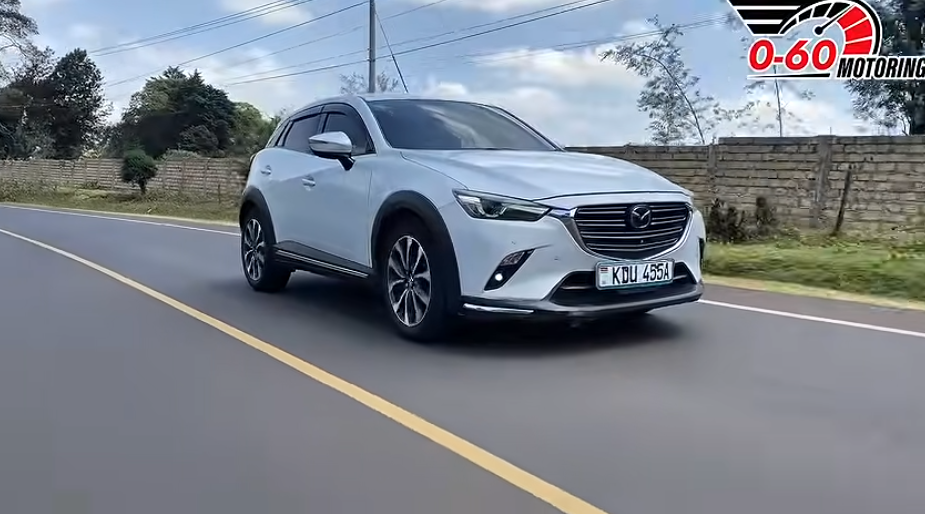
Built on the Demio platform, the CX-3 carries Mazda's signature Kodo "Soul of Motion" design language, giving it an unmistakable family resemblance to other Mazda models. Buyers should note this generation received a facelift in 2018, meaning 2015–2017 units look noticeably different from 2018-onward models like this one — the facelifted front grille gives it a fresher, more current appearance.
As a genuine crossover, it sits higher than a standard hatchback with 16 cm of ground clearance — not class-leading, but sufficient to comfortably clear typical obstacles and rough patches on Kenyan roads.
INTERIOR AND COMFORT
This particular unit represents a well-specified example of the CX-3, featuring half-leather seats with driver-seat memory function for two settings, heated front seats, and a heated steering wheel — genuine comfort features not always expected in this compact segment. The centre console includes an electric parking brake (an upgrade over the manual handbrake found in pre-facelift 2015–2017 models), freeing up usable console space.
Driver assistance technology is comprehensive for a compact crossover: a 360-degree camera system, head-up display with traffic sign recognition, cruise control, lane-keeping assist, parking sensors, and rear vehicle monitoring via the side mirrors. A boot-mounted subwoofer rounds out the package for buyers who value sound quality on longer trips.
The honest trade-off buyers need to understand: being based on the Demio platform, rear seat space is genuinely limited, particularly for taller passengers, and the boot is among the smallest in its class. This makes the CX-3 best suited to singles or couples rather than growing families — buyers needing to regularly transport passengers or cargo should look elsewhere in Mazda's crossover range.
ENGINE AND PERFORMANCE
The most significant change with the 2018 facelift was under the bonnet. Pre-facelift 2015–2017 Japanese-market units came exclusively with a 1.5-litre turbo diesel producing around 105 hp and 250 Nm of torque. From 2018 onward, Mazda replaced this with a 1.8-litre turbocharged diesel — the same engine found in the Mazda CX-30 and Mazda 3 — producing 115 hp and 270 Nm of torque, alongside a newly introduced 2.0-litre naturally aspirated petrol option shared with some Axela, Atenza and CX-5 models.
Important note for buyers specifically searching for a 2015–2017 petrol CX-3: this configuration was never offered in the Japanese market during those years, meaning it simply doesn't exist among typical Japan-sourced imports, despite occasional buyer inquiries assuming otherwise.
On the road, the 1.8-litre diesel delivers genuinely enjoyable performance for a compact crossover — torque is available from low RPM, making overtaking effortless, and the car handles corners with a composure and agility that stands out in this segment, with only minimal body roll for a crossover. Compared to the earlier 1.5-litre engine, this 1.8-litre unit feels noticeably smoother, quieter, and exhibits reduced turbo lag — a genuine engineering improvement rather than just a displacement increase.
Some road noise does filter into the cabin, though a Bose sound system (fitted to well-specified units like this one) does an excellent job masking it during regular driving.
FUEL ECONOMY AND RUNNING COSTS
Real-world fuel economy sits around 16 km/L on mixed, curvier roads, with the potential to reach up to 18 km/L on gentler, sustained highway driving. Manufacturer claims of 20 km/L haven't been matched in real-world testing, but importantly, this larger 1.8-litre engine hasn't sacrificed efficiency compared to its 1.5-litre predecessor — if anything, it performs slightly better, with the 1.5-litre topping out around 16.5 km/L in comparable testing.
On pricing, the market has shifted noticeably in recent years. A diesel CX-3 that could be purchased for around KES 1.7 million a few years ago now typically costs KES 2.2–2.4 million for a genuinely non-local-used 2019 unit, with the 2.0-litre petrol variant commanding a premium at KES 2.5–2.6 million.
RELIABILITY AND COMMON ISSUES
As with any diesel vehicle, consistent, sufficient driving distance is essential to prevent DPF (diesel particulate filter) clogging issues. This specific unit, covering roughly 40,000 km in about a year of ownership without requiring DPF deletion, demonstrates that regular, adequate-distance driving keeps this system healthy without intervention. Buyers who primarily do short commutes should seriously consider the 2.0-litre petrol variant instead, as infrequent short trips are precisely the driving pattern that causes DPF problems in diesel engines.
Diesel engines in general demand disciplined maintenance — using the manufacturer-recommended oil (5W-30) and adhering strictly to service intervals is non-negotiable for long-term reliability, particularly given the turbocharged nature of this engine. The transmission, whether 6-speed manual or automatic, has proven robust with no notable issues reported.
Before purchasing any used vehicle, it is important to verify the mechanical condition, history and ownership background. 0-60 Motoring assists clients through vehicle evaluation and sourcing to reduce the risk of buying problematic cars.
WHO SHOULD BUY THIS CAR?
Singles or couples wanting a compact, stylish, economical crossover
Buyers who regularly cover sufficient distance to keep a diesel engine healthy
Those prioritising engaging driving dynamics in a compact package
Buyers wanting genuine crossover ground clearance without stepping into a larger vehicle
WHO SHOULD AVOID THIS CAR?
Families needing genuine rear-seat space or meaningful boot capacity
Buyers who primarily do short commutes (better suited to the petrol variant)
Those specifically searching for a 2015–2017 petrol configuration (not offered from Japan)
Buyers wanting best-in-class cargo space in the compact crossover segment
0-60 MOTORING BUYING ADVICE
Choosing the right car goes beyond finding an attractive price. Factors such as reliability, maintenance costs, fuel economy and suitability for your lifestyle should guide the decision.
At 0-60 Motoring, our team helps customers identify vehicles that match their needs and budget through professional car scouting and consultancy. A compact crossover like the CX-3 is an excellent fit for the right lifestyle, but understanding its genuine space limitations upfront — rather than discovering them after purchase — makes all the difference in long-term satisfaction.
COMPETITORS
Subaru XV — Offers more interior accommodation at a similar price point, appealing to buyers needing extra space without a major budget increase.
Suzuki SX4 S-Cross — A comparably priced alternative with more generous cabin space than the CX-3.
Peugeot 2008 / Honda Vezel — Both sit within touching distance price-wise and offer more accommodating interiors for buyers prioritising space over Mazda's specific driving character.
Each of these alternatives has its own strengths, and the right choice ultimately depends on how much weight a buyer places on Mazda's driving dynamics and styling versus genuine interior space — an area where professional guidance can help clarify the right fit.
FINAL VERDICT
The 2019 Mazda CX-3 is a genuinely enjoyable compact crossover for the right buyer — delivering engaging handling, strong fuel economy, and a well-equipped cabin in a smaller footprint than most rivals. Its clear limitation is space: this is not a family car, and buyers needing genuine rear-seat or boot capacity will be better served elsewhere in Mazda's range or by competitors like the Subaru XV or Honda Vezel. For singles, couples, or anyone prioritising economy and driving enjoyment over outright space, however, it remains a genuinely satisfying choice.
If you are considering purchasing a Mazda CX-3 or any other vehicle, 0-60 Motoring can help you find a clean, suitable car through our vehicle scouting and consultancy services. Contact our team before making your next purchase decision.
FAQ
Is the Mazda CX-3 reliable in Kenya?
Yes, provided the diesel variant is driven consistently enough to keep the DPF system healthy; the transmission has also proven robust.
How much fuel does the Mazda CX-3 diesel consume?
Real-world driving returns around 16–18 km/L, depending on road conditions and driving style.
Is the Mazda CX-3 good for families?
No, rear seat space and boot capacity are genuinely limited due to its Demio-based platform, making it better suited to singles or couples.
Should I buy the diesel or petrol Mazda CX-3?
Choose diesel if you cover sufficient regular distance; choose the 2.0L petrol if you primarily do short commutes, to avoid DPF clogging issues.
How much does a 2019 Mazda CX-3 cost in Kenya?
Diesel variants typically cost KES 2.2–2.4 million, while the 2.0L petrol variant runs around KES 2.5–2.6 million.
What should I inspect before buying a used Mazda CX-3?
Check DPF condition and service history, particularly for diesel units, and confirm overall mechanical condition and ownership records.
Is 0-60 Motoring able to source a Mazda CX-3 for me?
Yes, our car scouting program can source a Mazda CX-3 or comparable compact crossovers based on your specific needs and budget.
What is the difference between the 2015-2017 and 2019 Mazda CX-3?
The 2018 facelift introduced a smoother 1.8L diesel (replacing the 1.5L) and added a 2.0L petrol option, alongside revised front-end styling.