10/4/2026
2019 Suzuki Swift Sport Review Kenya: Performance, Handling & Buying Guide
The Suzuki Swift needs no introduction in Kenya — it's one of the most common hatchbacks on local roads. The Swift Sport, however, is an entirely different proposition: a genuine performance variant built for buyers who want driving engagement rather than just basic A-to-B transport, and priced accordingly as the most expensive car in its class. The Swift Sport tends to attract a specific kind of buyer — someone who understands turbocharged performance and values driving feel over badge economy. At 0-60 Motoring, we help buyers make informed vehicle decisions through professional car consultancy and vehicle sourcing, and this review is meant to give you an honest, practical breakdown of what sets this car apart from the standard Swift lineup, and whether its premium pricing is genuinely justified.
QUICK VEHICLE SUMMARY
Make: Suzuki
Model: Swift Sport
Year: 2019
Engine: 1.4L turbocharged Boosterjet petrol
Power: 140 hp
Torque: 230 Nm
Fuel economy: 14–17 km/L (real-world)
Drive type: Front-wheel drive, 6-speed manual or automatic
Ideal buyer: Performance-focused buyers wanting an engaging, lightweight hot hatch
EXTERIOR DESIGN
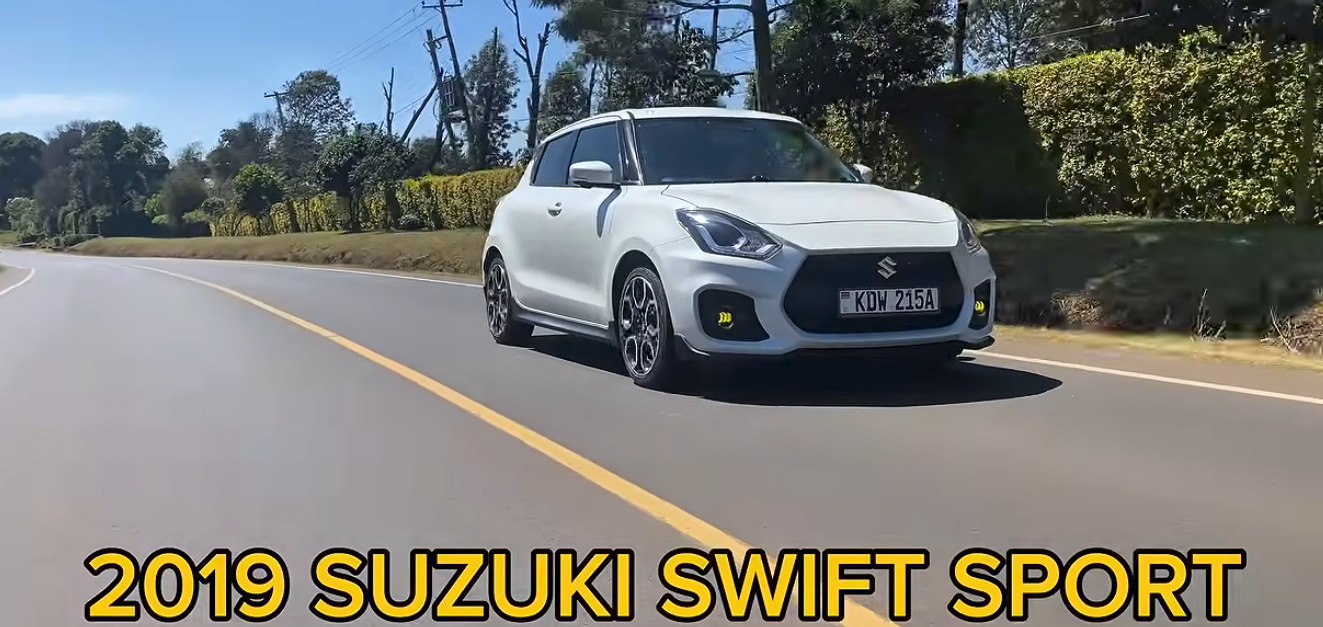
Unlike the entry-level Swift, the Sport variant is unmistakably performance-oriented from the outside. A dual exhaust setup, larger 17-inch alloy wheels (versus 15-inch on standard models), and disc brakes front and rear all signal genuine mechanical differences, not just cosmetic badging. The front end carries a distinct grille, different fog lamps, and a sportier lip design that visually separates it from both the entry-level Swift and the related Swift RS variant — an important distinction, since the two names are frequently and incorrectly conflated in casual conversation, despite being genuinely different cars.
INTERIOR AND COMFORT
The cabin reflects the car's performance focus throughout. Bucket seats provide genuine lateral support during spirited cornering, and the deliberate absence of an armrest reinforces the sports-car intent — your hands are meant to stay on the wheel. Steering-mounted controls include volume knobs on the left and cruise control on the right, with paddle shifters for the automatic transmission.
One notable quirk: only the driver's seat is heated, with the passenger side left unheated — a minor but curious omission for a car at this price point. Safety features include collision mitigation and lane-keeping assist alongside cruise control.
As with any compact hot hatch, rear seat legroom and boot space are genuinely limited — this isn't a car bought for practicality, and buyers should understand that upfront. It suits a single person or a small family well, but isn't designed to compete on outright space with larger hatchbacks or SUVs.
ENGINE AND PERFORMANCE
Under the bonnet sits a 1.4-litre turbocharged Boosterjet petrol engine — the same unit found in the Suzuki SX4 S-Cross and Suzuki Escudo — producing 140 hp and 230 Nm of torque in stock form, sent to the front wheels via either a 6-speed manual or 6-speed automatic transmission.
What makes these power figures genuinely impressive is the car's weight: at just 970 kg, the Swift Sport's power-to-weight ratio actually exceeds that of a stock Volkswagen Golf GTI, which produces more power but carries considerably more weight. This isn't a claim that it's outright faster than a GTI — the GTI's DSG gearbox changes that equation — but it illustrates genuinely serious performance credentials for a car in this price bracket.
On the road, this is widely regarded as the best-driving car in its segment, ahead of direct rivals like the Nissan Note Nismo S, Honda Fit RS, and Toyota Vitz RS. Two factors drive this: first, the exceptional power-to-weight ratio translates into genuinely effortless real-world acceleration, with the car comfortably maintaining highway speeds even with multiple occupants aboard. Second, the handling is genuinely exceptional — nimble, agile and composed through corners in a way that clearly separates it from other hatchbacks in this class, aided significantly by keeping the suspension in stock configuration rather than modifying ride height.
The 6-speed automatic transmission shifts smoothly and intelligently, making it a genuinely viable choice for buyers who share the car or spend significant time in traffic, while purists wanting maximum driving engagement will still prefer the manual. One honest criticism: the factory exhaust note doesn't quite match the car's performance character, leaving some buyers wanting more aural feedback — though this is a popular area for aftermarket modification.
FUEL ECONOMY AND RUNNING COSTS
Remarkably for a genuine performance hatchback, the Swift Sport delivers real daily-driver efficiency. City driving in Nairobi returns around 15.8 km/L, with the potential to reach 17 km/L on conservative highway trips. Even driven enthusiastically with frequent use of the turbo's boost, fuel economy rarely drops below 14 km/L — genuinely impressive figures given the performance on offer, and numbers few other cars in this segment can match while delivering comparable driving engagement.
On pricing, a well-kept, low-mileage 2019 unit typically costs around KES 1.85–1.9 million in the Kenyan market. While this positions it above rivals like a fully-loaded Mazda 2 (KES 1.65 million) or Nissan Note Nismo S (KES 1.65–1.7 million), none of those alternatives come close to matching the Swift Sport's driving dynamics and engagement — a genuine consideration for buyers who prioritise driving feel over pure economy.
RELIABILITY AND COMMON ISSUES
The most commonly reported weakness on this platform involves engine mounts, which can be costly to replace when they eventually fail — though this isn't a frequent occurrence and shouldn't be viewed as a deterrent to purchase. Some owners also report occasional boost leaks, generally straightforward and inexpensive to resolve.
Being a turbocharged engine, this 1.4-litre unit demands more diligent care than the naturally aspirated 1.6-litre found in the previous-generation Swift Sport — consistent oil level monitoring is essential to avoid turbo damage from oil starvation. Transmission reliability is strong on both the manual and automatic variants, with no CVT-related concerns to worry about, unlike many rivals in this segment.
For buyers interested in modifications, the Boosterjet engine responds well to tuning — a stage one tune can push output to around 160 hp and 300 Nm with minimal reliability risk, though more aggressive stage two tuning (up to 200 hp) introduces greater risk for a daily-driven car and is better suited to dedicated track use.
Before purchasing any used vehicle, it is important to verify the mechanical condition, history and ownership background. 0-60 Motoring assists clients through vehicle evaluation and sourcing to reduce the risk of buying problematic cars.
WHO SHOULD BUY THIS CAR?
Performance-focused buyers wanting genuine driving engagement in a compact hatchback
Singles or small families prioritising driving experience over outright space
Buyers wanting strong fuel economy without sacrificing performance
Those who appreciate turbocharged power delivery and nimble handling
WHO SHOULD AVOID THIS CAR?
Families needing genuine rear-seat legroom or boot capacity
Buyers unwilling to monitor oil levels diligently on a turbocharged engine
Those wanting the cheapest possible entry point in the compact hatchback segment
Buyers planning aggressive engine modifications without accepting the added reliability risk
0-60 MOTORING BUYING ADVICE
Choosing the right car goes beyond finding an attractive price. Factors such as reliability, maintenance costs, fuel economy and suitability for your lifestyle should guide the decision.
At 0-60 Motoring, our team helps customers identify vehicles that match their needs and budget through professional car scouting and consultancy. A performance-oriented car like the Swift Sport rewards buyers who understand what they're getting — genuine driving thrills paired with turbo-specific maintenance discipline — and our consultancy process helps ensure that match is the right one before you commit.
COMPETITORS
Nissan Note Nismo S — A comparably priced sporty hatchback alternative, though generally regarded as less engaging to drive than the Swift Sport.
Honda Fit RS — Offers sportier styling at a similar price point, without quite matching the Swift Sport's power-to-weight advantage.
Mazda 2 (fully loaded) — More affordable and economical, but without the genuine performance character the Swift Sport delivers.
Each of these alternatives has its own strengths, and the right choice ultimately depends on how much weight a buyer places on genuine driving engagement versus straightforward economy and practicality — an area where professional guidance can help clarify the right fit.
FINAL VERDICT
The 2019 Suzuki Swift Sport stands out as the most genuinely engaging hatchback available in its price class from the Japanese market — combining a strong power-to-weight ratio, exceptional handling, and surprisingly good fuel economy in one compact, well-built package. Its practicality trade-offs are real, and buyers specifically needing rear-seat space or cargo capacity should look elsewhere, but for anyone prioritising driving enjoyment without sacrificing daily usability, this remains one of the best choices in its segment — short of stepping up to something like a Golf GTI.
If you are considering purchasing a Suzuki Swift Sport or any other vehicle, 0-60 Motoring can help you find a clean, suitable car through our vehicle scouting and consultancy services. Contact our team before making your next purchase decision.
FAQ
Is the Suzuki Swift Sport reliable in Kenya?
Yes, with disciplined oil maintenance; the main known weakness is occasional engine mount failure, which is manageable and not frequent.
How much fuel does the Suzuki Swift Sport consume?
Real-world driving returns 14–17 km/L, impressive figures for a genuine performance hatchback.
What is the difference between the Swift Sport and Swift RS?
They are distinct variants with different styling and specifications — "Swift RS Sport" is not an actual model designation.
How much does a 2019 Suzuki Swift Sport cost in Kenya?
A well-kept, low-mileage unit typically costs around KES 1.85–1.9 million.
Can the Suzuki Swift Sport be tuned for more power?
Yes, a stage one tune can safely push output to around 160 hp and 300 Nm with minimal reliability risk.
What should I inspect before buying a used Suzuki Swift Sport?
Check engine mount condition, look for signs of boost leaks, and verify overall service and ownership history.
Is 0-60 Motoring able to source a Suzuki Swift Sport for me?
Yes, our car scouting program can source a Suzuki Swift Sport or comparable performance hatchbacks based on your specific needs and budget.
Is the Suzuki Swift Sport good for families?
Not ideally — rear seat and boot space are genuinely limited, making it better suited to singles or small families.